
You’ve arrived in London, but your body is still somewhere between the airport, the train carriage and the taxi.
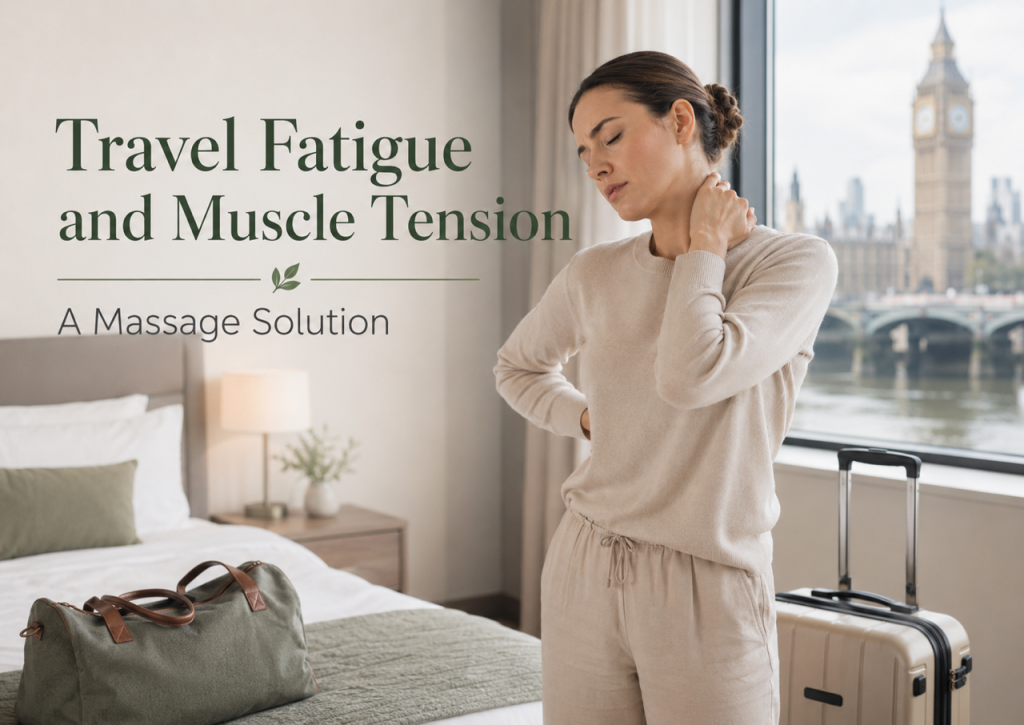
Your lower back feels tight. Your hips are stiff. Your shoulders have that heavy, loaded feeling that comes from carrying luggage and sitting still for too long. If you’ve crossed time zones as well, you may be exhausted and oddly wide awake at the same time. That mix of stiffness, tension and sleep disruption is not indulgent-spa territory. It is simple travel fatigue, and it is one of the most practical reasons to book a massage when you get to Central London. The CDC notes that long-distance travel can leave people dealing with circadian disruption, poor sleep and physical symptoms made worse by dehydration and inactivity.
A lot of travellers assume the answer is just to rest in the hotel for a while. Sometimes that helps. But rest alone does not always undo what the journey has done to your body.
After hours on a plane or train, you have usually been sitting in one fixed position, often with your hips bent, your lower back compressed, your neck slightly strained and your shoulders rounded forward. Even if the journey was comfortable by travel standards, your muscles have still been working in a static, awkward way for much longer than they were designed to. Inactivity is well known to increase stiffness and reduce muscular ease, which is one reason people often feel slow and sore when they first stand up after a long trip.
That is why travel soreness tends to show up in the same places.
The lower back often feels compressed. The hips and glutes tighten from staying folded for hours. Calves can feel heavy. The neck and shoulders often carry tension from sleeping badly in transit, handling bags, or bracing unconsciously through the journey. By the time you reach Covent Garden or Trafalgar Square, you may technically be on holiday, but your body is still in “travel mode”.
Massage helps because it gives your body a much more active form of recovery than simply waiting it out.
A good treatment works on the stiffness that comes from prolonged sitting and the muscular tension that builds during travel. It can help overloaded areas soften, make movement feel easier again, and leave you feeling less like you have just spent eight hours folded into a seat. Massage is also often experienced as deeply calming, which matters if travel has left you tired but unable to switch off. Relaxation approaches are associated with the body’s relaxation response, including slower breathing and a calmer physiological state, which can be useful when travel stress and disrupted sleep are part of the picture.
That is one of the biggest reasons travellers find massage so useful: it is not only about comfort in the moment.
It can help you sleep better on your first night in London. It can make it easier to walk, sightsee, sit through meetings or enjoy dinner without that dragging, travel-weary feeling. If you have flown in for work, it can help you feel more alert and physically settled. If you are here for a city break, it can mean spending your first full day actually enjoying London instead of moving like someone who has just stepped off a long-haul flight.
The jet lag side matters too, but it helps to be honest about it. Massage does not directly reset your body clock in the way that light exposure and sleep timing do. The CDC is clear that jet lag is mainly about circadian misalignment, and that strategies like timing sleep to destination time, getting natural light and avoiding long daytime naps are central. But massage can still be useful because it helps with the physical restlessness, tension and overactivation that often make that adjustment harder.
This is why so many travellers end up saying the same thing after a good session: they simply feel more like themselves again.
Not “pampered”. Not transformed into a new person. Just more comfortable, more mobile, and more able to settle into the trip. That is the real value of massage after travel. It is practical recovery.
And if you are already staying in Central London, it is also very easy to act on. You do not need to travel across the city feeling sore and sluggish when recovery is already nearby. If you are around Covent Garden or Trafalgar Square, booking a treatment early in your stay is often one of the simplest ways to make the rest of the visit feel better.
If your body feels tight, heavy or travel-worn after the journey in, do not write it off as something you just have to tolerate until tomorrow. Book a Swedish Massage if you want a gentler full-body reset, or choose a Sports Massage if the tension feels more specific and muscular. The sooner you help your body recover, the sooner you can get on with enjoying London properly.