

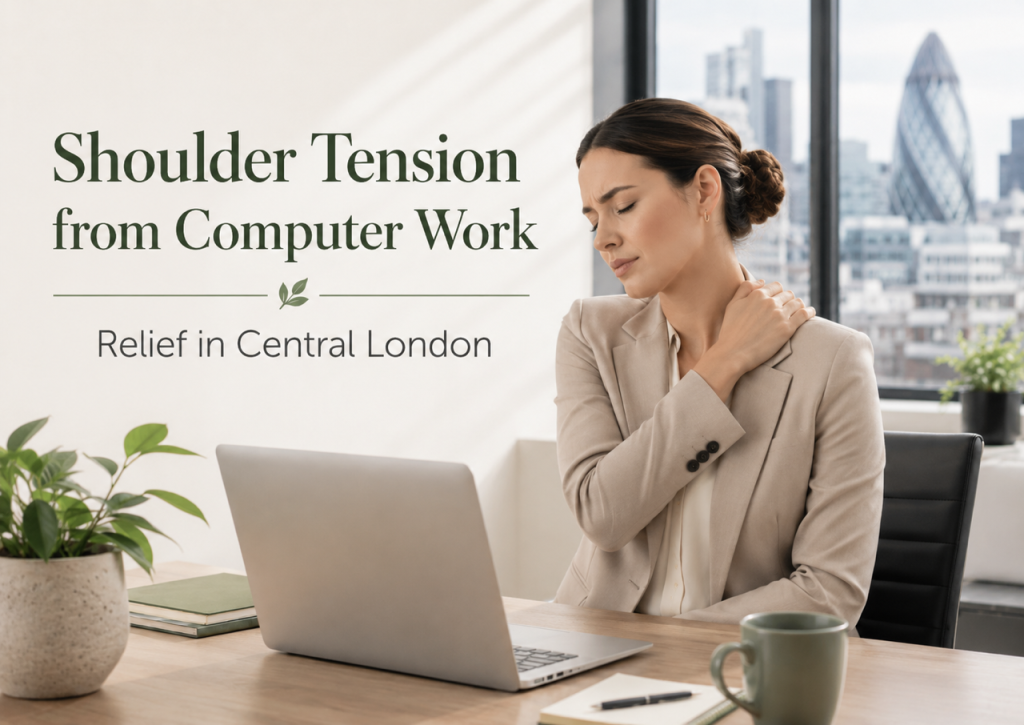
You probably don’t notice your shoulders rising until they’re already up near your ears.
It happens quietly. A few hours at the computer. A rushed morning. Another meeting. Another stretch of emails. By the middle of the day, your upper shoulders feel heavy, your neck is tight, and reaching for your mouse or turning your head starts to feel harder than it should. If you work around Covent Garden, the City or Trafalgar Square, this is one of the most common desk-work patterns there is. NHS workstation guidance notes that prolonged sitting and poor posture can create muscle fatigue around the shoulders, neck and back, and that overreaching at the desk builds tension around the neck and shoulders.
The real culprit is usually your trapezius
One of the main muscles involved is the trapezius — especially the upper part, which runs from the neck across the top of the shoulders. When you spend hours working with your arms in front of you, shoulders slightly lifted, head drifting forward and upper back rounded, the trapezius has to keep working even when it should be resting. Over time it becomes tired, tight and irritable. NHS posture and ergonomics guidance consistently links desk posture, slumping and prolonged sitting with neck, shoulder and upper-back strain. (Cambridge University Hospitals)
That is also why shoulder tension is rarely “just shoulder tension”. Once the trapezius stays loaded for long enough, other muscles join in. The neck stiffens. The muscles between the shoulder blades start aching. Trigger points can develop in overworked tissue, creating those familiar knots that feel tender under the fingers and can refer discomfort upward into the neck or head. The result is the classic desk-worker pattern: heavy shoulders, reduced movement, and a body that feels as though it has been carrying the workday physically. NHS headache and posture guidance supports the link between upper-back and neck tension and head pain.
Why ignoring it usually makes it worse
A lot of people get used to this pattern. They shrug their shoulders, roll their neck, stand up for a minute, then sit back down and carry on. But if the setup and the habits stay the same, the tension usually does not disappear. It accumulates.
That is why shoulder discomfort often starts as a nuisance and becomes something more persistent. By late afternoon your shoulders feel hard and lifted. By evening, your neck joins in. After weeks of that, poor posture becomes easier, not because it is better, but because the muscles have adapted to it. NHS desk advice recommends frequent adjustment of the chair and workstation, keeping the keyboard and mouse close, and moving regularly because static posture and poor setup increase the strain on the neck and shoulders.
Why massage helps more than just stretching at your desk
A quick stretch can help a little. So can improving your ergonomics. Both are worth doing.
But if the trapezius and surrounding muscles have been tight for weeks or months, a short stretch at your desk often only scratches the surface. Massage works differently because it addresses the muscle tissue that has been holding all that tension. A focused treatment can work directly into the upper trapezius, the neck, the top of the shoulders and the upper back, helping the area soften and move more normally again. That is why clients often describe the feeling afterwards as almost magical — not because anything mysterious happened, but because the body has finally stopped bracing. NHS self-help guidance also emphasises regular movement and exercises for desk workers because these areas commonly tighten with prolonged sitting.
In practice, this is where Deep Tissue Massage and Remedial Massage make the most sense. Deep tissue work is useful when the shoulders feel stubbornly hard, loaded and full of built-up tension. Remedial work is ideal when you want a treatment that looks at the pattern more broadly — the trapezius, the upper back, posture, desk habits and the way one tight area is affecting the rest. The point is not just to rub where it hurts. It is to change the pattern that keeps creating the pain. This is consistent with ergonomics guidance that encourages addressing posture, support and movement habits rather than only the symptom itself.
What clients usually say
The most common reaction is surprise.
People come in thinking their shoulders are “a bit tight”, and once the tension starts releasing, they realise how much they had been carrying. Shoulders feel lower. The neck turns more easily. Breathing feels less restricted. That is the part clients often describe as magical — the moment their body suddenly feels lighter than it did an hour earlier.
And the earlier you deal with it, the easier it usually is. If you wait until shoulder tension has become your everyday normal, it tends to drag the neck and upper back along with it. If you deal with it now, you are much more likely to stop that pattern before it settles in more deeply. NHS advice also supports keeping active and adjusting workstations early to avoid worsening musculoskeletal strain.
A practical next step in Central London
If you work near Covent Garden, the City or Trafalgar Square and your shoulders feel tight most days, this is usually the point where “I should probably sort this” becomes true.
Book a Deep Tissue Massage if your shoulders feel heavily loaded and stubbornly tense. Book a Remedial Massage if you want a more targeted treatment that works on the trapezius, posture pattern and desk-related strain together.
You do not need to wait until your shoulders become a bigger problem. The sooner you deal with desk tension, the easier it is to get ahead of it.