
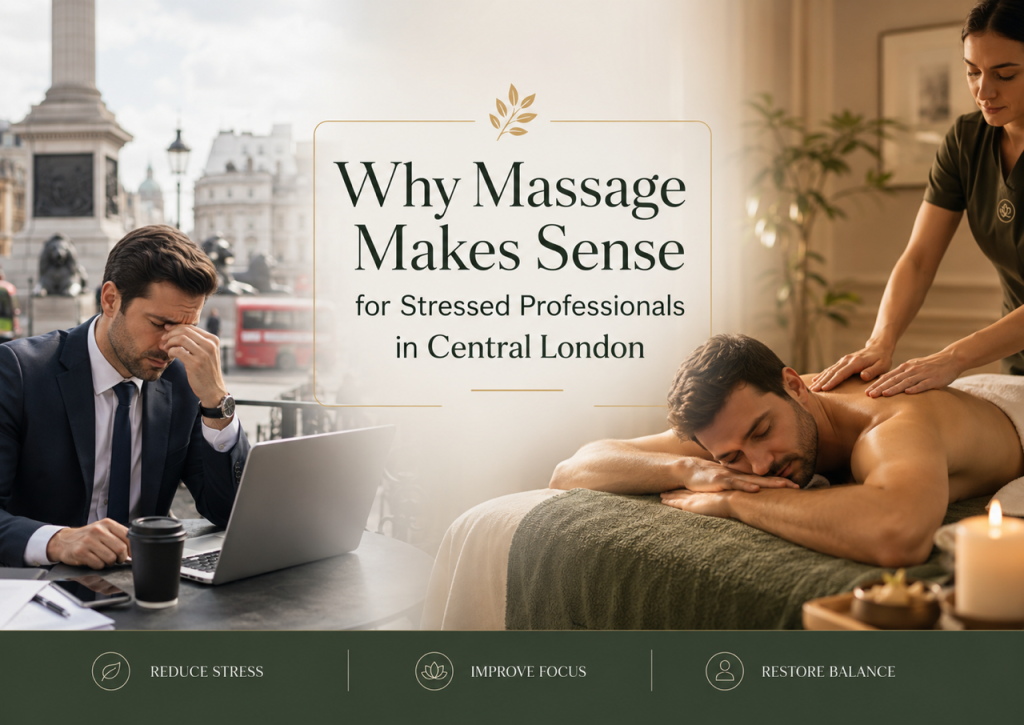
If you work in the City, around Trafalgar Square, or somewhere between Covent Garden meetings and a crowded commute, stress can start to feel like part of the job description.
Not dramatic stress. Not always obvious stress. More the steady, background kind that leaves your shoulders tight, your jaw clenched, your breathing shallow, and your body feeling switched on long after work has finished. The NHS lists muscle tension or pain, headaches, faster heartbeat, and sleep problems among common physical symptoms of stress.
This is the part many busy professionals miss: stress does not stay in the mind. It shows up in the body.
When pressure is constant, your system leans towards a stress response. Muscles tighten. Breathing gets shorter and higher in the chest. Sleep becomes lighter or more broken. Over time, that physical pattern can start to feel normal, which is exactly why so many high-functioning people do not realise how much tension they are carrying until it starts to affect their neck, back, energy, or concentration.
This is where massage becomes practical, not indulgent.
Massage helps by giving your body a chance to move in the opposite direction: away from constant alertness and towards the relaxation response. NCCIH describes this response as the opposite of the stress response, associated with slower breathing, lower blood pressure, and a reduced heart rate. That is why people often notice very concrete changes after a good session: shoulders dropping, breathing deepening, jaw tension easing, and the whole body feeling less guarded.
The benefits are not vague. Clients often say they sleep more deeply that night, wake feeling less braced, and cope better with the next working day. Those are not just “nice” effects. They are what happens when the nervous system gets a genuine chance to downshift and the muscles stop holding on so hard. NHS Every Mind Matters also links stress with trouble sleeping and muscle pain, which is why reducing physical tension can matter so much.
If your stress mostly shows up as general overload, poor sleep, and a body that never quite unwinds, a Swedish Massage is often the best fit. If the pattern is more specific — tight shoulders, headaches, jaw tension, or that “wired but tired” feeling — a Personalized Massage or Deep Tissue Massage may make more sense.
In a fast-paced Central London working life, regular massage is less a treat than a sensible maintenance strategy. If your body has been absorbing the cost of your workload for weeks, booking now is often the smartest point to act.