

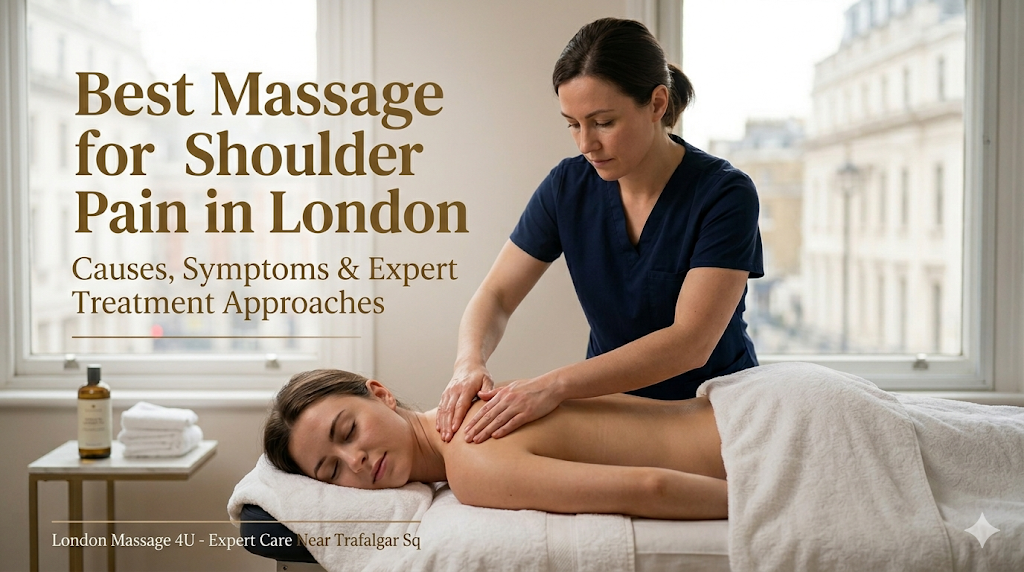
Shoulder pain is one of the most common problems I see in my treatment room in Central London. Sometimes it starts as a mild ache near the shoulder blade. Sometimes it feels like tightness across the top of the shoulder, discomfort when reaching overhead, or a pulling sensation into the neck during desk work. For some people, it shows up when lifting a bag, fastening a bra, sleeping on one side, or trying to exercise as normal.
What makes shoulder pain frustrating is that it rarely stays in one small area. It often spreads into the neck, upper back, or arm, and everyday movements can begin to feel stiff, heavy, awkward, or restricted.
The good news is that many shoulder pain patterns respond well to the right hands-on treatment, especially when muscular overload, posture, stress, reduced movement, or desk-related tension are part of the picture. But I think it is important to say this clearly and honestly: not all shoulder pain is the same. NHS and NICE guidance both make that clear. Shoulder symptoms can also be linked with rotator cuff disorders, frozen shoulder, instability, impingement, arthritis, and other joint-related problems, so it is important not to assume every painful shoulder is simply “tight muscles”.
Why Shoulder Pain Is So Common
The shoulder is involved in almost everything you do. Sitting at a desk, typing, driving, reaching, lifting, carrying bags, training in the gym, sleeping on one side, and even the way you breathe under stress can all change how the shoulder girdle is loaded through the day.
In practice, I see the same patterns again and again:
- long hours sitting at a desk
- constant computer or laptop use
- rounded upper-body posture
- stress and shallow breathing
- carrying a bag on one side
- repeated reaching or lifting
- gym training without enough mobility or recovery work
Over time, this can leave some muscles overworked and guarded, while others become less active and less supportive. NHS advice specifically highlights posture, movement, and activity-related irritation as common contributors to shoulder pain, and advises people not to completely stop using the shoulder, not to slouch, and to keep the area moving gently. (nhs.uk)
What May Be Causing Your Shoulder Pain?
Shoulder pain is not one single diagnosis. In many cases, it is a combination of muscle tension, movement restriction, irritation around the joint, and poor load management. That is why a good treatment plan should never be based on guesswork alone.
Upper trapezius and neck-shoulder tension
This is very common in people who work at a desk, feel stressed, drive often, or spend hours with the shoulders slightly elevated without realising it. The upper trapezius and surrounding muscles become overworked, and the result can be heaviness through the shoulders, pulling into the side of the neck, or a tired, braced feeling across the upper body.
Tension around the shoulder blade
Many clients describe this as a gripping, burning, or “stuck” sensation between the shoulder blade and the spine. It often develops when the upper body is held still for long periods, especially during computer work. The tissues around the shoulder blade can become irritated, fatigued, and sensitive, even if the main problem seems to be “inside the shoulder”.
Rounded shoulders and desk posture
When the shoulders spend hours drifting forwards, the chest, front of the shoulder, and upper neck often do too much work, while the upper back contributes less effectively. NHS advice warns against slouching and rolling the shoulders forwards for good reason: posture and repeated position matter, especially when they are sustained every day. (nhs.uk)
Rotator cuff-related shoulder pain
This is one of the most common shoulder pain patterns seen in primary care. NICE notes that rotator cuff disorders are among the main causes to consider, and that subacromial shoulder pain from rotator cuff disorders is the most common shoulder pain presentation in primary care. This kind of pain often builds gradually. It may be felt when lifting the arm, reaching out to the side, taking off a top, lying on the affected side, or doing repeated overhead movement. It can also spread into the upper arm, neck, or shoulder blade area. (CKS)
Frozen shoulder or a stiff, painful shoulder
Frozen shoulder behaves differently from ordinary tension. NHS guidance describes it as shoulder pain with marked stiffness lasting for months, sometimes years, often with night pain and obvious difficulty moving the shoulder. If both pain and stiffness are becoming more pronounced over time, and especially if your shoulder movement is clearly restricted, frozen shoulder may need to be considered. In those cases, massage may help with surrounding tension and comfort, but it is usually not the whole answer on its own. (nhs.uk)
Training overload and poor recovery
I also see a lot of shoulder discomfort in gym clients and active people. Repeated pressing, pulling, or overhead work without enough recovery, mobility, technique work, or variation can create irritation and restriction around the shoulder complex. That does not always mean injury, but it does mean the shoulder may need a more thoughtful treatment approach than simply “pushing through”.
Common Symptoms of Shoulder Pain
Shoulder pain does not feel the same for everyone, but these are some of the symptoms clients most often describe to me:
- a dull ache in the shoulder
- pain around or behind the shoulder blade
- tightness spreading into the neck
- discomfort when lifting the arm
- stiffness when reaching behind the back
- weakness or heaviness in the arm
- pain when carrying bags
- discomfort at night
- clicking, catching, or a blocked feeling
- a feeling that the shoulder is not moving normally
NHS advice highlights ongoing pain, difficulty moving the arm or shoulder, worsening symptoms, weakness, pins and needles, and pain or stiffness that continues for months as signs that the problem may need more careful assessment rather than self-diagnosis.
Can Massage Help Shoulder Pain?
In many cases, yes — but the key is choosing the right type of treatment for the right type of problem.
When shoulder pain is being driven by muscular overload, upper-body tension, reduced movement, stress, postural strain, or soft tissue restriction, massage can be very helpful. My aim in treatment is usually to do three things:
- reduce excessive muscle tension and guarding
- improve comfort and range of movement
- help the nervous system settle so the shoulder is not bracing all the time
What I do not do is pretend massage is the answer to every shoulder problem. If the issue is frozen shoulder, a significant rotator cuff injury, instability, or something more clearly joint-related, massage may still have a useful role, but it may need to sit alongside exercise, physiotherapy, medical assessment, or a wider rehabilitation plan. NHS guidance reflects this broader approach by listing exercises, physiotherapy, activity advice, and further assessment as part of shoulder pain management depending on the cause.
What Is the Best Massage for Shoulder Pain?
The best massage for shoulder pain in London really depends on what is driving the problem. In my practice, I tailor treatment to the pattern I find rather than using the same routine for everyone.
Deep tissue massage for shoulder tension
Deep tissue massage is often a strong option when the shoulder feels heavy, tight, overworked, and full of built-up tension — especially if the discomfort also spreads into the neck or upper back.
This is often a good fit for:
- desk-related upper-body tension
- upper trapezius tightness
- shoulder heaviness linked with posture
- stress-related bracing through the neck and shoulders
- upper-body stiffness after travel or long workdays
In these sessions, I rarely work on the shoulder alone. I usually look at the neck, upper back, shoulder blade region, and often the chest as well, because those areas are frequently part of the same pattern.
Sports massage for shoulder stiffness and movement restriction
Sports massage is often the better choice when the shoulder feels restricted, blocked, or limited rather than simply sore. It works particularly well when the pain is linked with gym training, recurring postural strain, upper-back stiffness, reduced mobility, or a sense that the shoulder is “not moving properly”.
Depending on the presentation, I may combine:
- soft tissue work
- mobility-focused treatment
- myofascial work
- stretching techniques
- simple movement-based advice
This approach can be especially useful for active clients and desk workers who need the shoulder to move better, not just feel less tense.
Cupping therapy as an optional add-on
Cupping can sometimes be useful as a supportive option where the tissues around the upper back and shoulder blade feel very tight or sensitive to direct pressure. Some clients find it helpful in combination with other hands-on work.
That said, I position cupping honestly. It is not the main evidence-based answer for every shoulder problem, and I would not frame it as the primary treatment if the pattern looks more joint-related, more irritable, or more consistent with rotator cuff or frozen shoulder issues.
Personalised massage for mixed symptoms
Many people do not come in with one neat textbook problem. They come in with a combination of symptoms, such as:
- shoulder pain and neck pain
- shoulder tension and headaches
- shoulder stiffness with rounded desk posture
- gym-related tightness plus poor sleep and stress
- upper-back tension alongside painful lifting or reaching
A personalised massage session allows me to work more precisely. I can combine deep tissue work, sports massage techniques, upper-back and neck treatment, chest and front-of-shoulder release, mobility-focused work, and optional cupping depending on what your body actually needs on the day.
How Many Sessions Might You Need?
This depends on the cause, how long the pain has been there, how irritable the shoulder is, and how much your daily routine keeps re-triggering it.
As a general guide:
- mild muscular tension may ease within 1 to 2 sessions
- more established tension often needs a short course of treatment
- recurring or stubborn symptoms usually need a more consistent plan
- if desk work, training, or stress keeps feeding the problem, maintenance treatment can be useful
I think it is important to be honest here. If your shoulder pain is linked with frozen shoulder, marked stiffness, significant weakness, or a more structural issue, massage may still help with surrounding soft tissue tension and overall comfort, but it may not resolve the problem on its own. NHS notes that shoulder pain can take 6 months or longer to recover from depending on the cause, and frozen shoulder in particular can last for months or years.
Self-Care Tips for Shoulder Pain
What you do between sessions matters. A few simple habits can make a real difference.
- keep the shoulder moving gently rather than stopping completely
- avoid slouching at your desk
- adjust your sitting position and screen height
- rest the arm on a cushion if that feels easier
- use heat or cold depending on what suits you better
- avoid repeatedly aggravating overhead movement
- do appropriate shoulder exercises if a physio or clinician has advised them
- be cautious with heavy gym work or made-up exercises when the shoulder is already irritated
This is very much in line with NHS advice, which recommends staying active, gently moving the shoulder, trying shoulder exercises for several weeks, using heat or cold packs, avoiding slouching, and not completely stopping use of the shoulder.
When to Seek Medical Help for Shoulder Pain
Massage is often appropriate for muscular shoulder pain, but some symptoms need medical assessment rather than hands-on treatment alone.
You should seek medical advice if:
- the pain is getting worse
- it does not start improving after 2 weeks
- it is very difficult to move your arm or shoulder
- you have sudden or very severe shoulder pain
- you cannot move the arm
- the arm feels weak, numb, or tingly
- your shoulder or arm has changed shape or is badly swollen
- the pain started after a fall, injury, or accident
- the shoulder is hot or cold to touch
- you feel feverish or unwell
- you have pain and stiffness that continue for months
These red flags are consistent with current NHS guidance and are exactly why I do not believe in oversimplifying shoulder pain. Sometimes massage is the right starting point. Sometimes it should come after medical review.
Shoulder Pain Massage in Central London
If your shoulder feels tight, overworked, stiff, or restricted, I offer personalised shoulder pain massage in Central London based on what is actually driving your symptoms.
My treatment room is at Golden Cross House, 8 Duncannon Street, 2nd Floor, Room 203, WC2N 4JF, close to Charing Cross and Trafalgar Square — convenient for office workers, commuters, visitors, and anyone who wants thoughtful, one-to-one treatment in Central London.
Whether your shoulder pain is linked with desk work, stress, upper-back tension, postural strain, or gym overload, I will adapt the session to focus on the neck, shoulders, upper back, shoulder blade region, and surrounding tissues that may be contributing to the problem.
And if your symptoms suggest something more complex — such as frozen shoulder, clear weakness, major stiffness, or a problem that needs medical assessment — I will say so honestly.
If that sounds like the kind of treatment approach you are looking for, you are very welcome to book.
London Massage 4U
Golden Cross House, 8 Duncannon Street, 2nd Floor, Room 203, WC2N 4JF
Charing Cross / near Trafalgar Square
+44 7786 971943
You may also be interested in:
- Deep Tissue Massage in Central London
- Sports Massage in Central London
- Massage for Neck Pain
- Massage for Desk Workers
For clinical accuracy, this rewrite was checked against current NHS and NICE shoulder pain guidance.